
We’re now on Issue #4 of our bi-weekly Stop Bad Data Centers newsletter, so I thought I’d take a moment to introduce myself.
Hi! I’m Elissa Yoder, Data Center Fellow with Halt the Harm Network. You might recognize me as a webinar host or network moderator.
A lot of my work is about connecting people—sharing resources, facilitating conversations, and helping folks connect and find answers in a space that can feel confusing or overwhelming. I also spend time reading, organizing, and translating research so it’s actually useful on the ground.
More than anything, I want people to feel supported and not like they’re doing this work alone. So if you need help with anything at all, just hit reply to this email and I’ll get back to you as soon as possible.
Thanks so much for being here!
This bi-weekly newsletter is a new project from Halt the Harm Network. For more regular updates and meetups on data center organizing, request access to the Stop Bad Data Centers group inside the HHN community space.
Strategy Notes
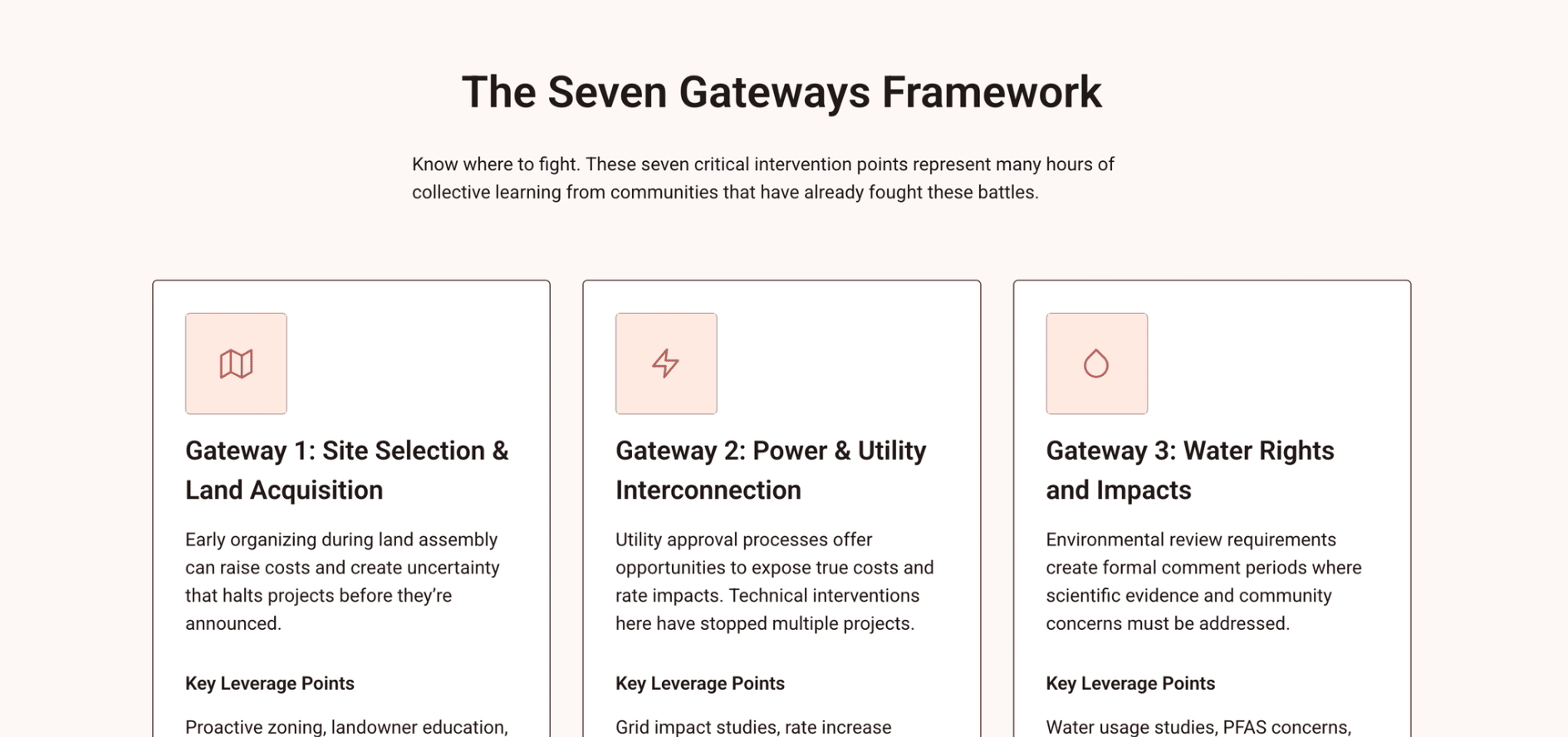
The Seven Gateways Framework
The SBDC “Gateway” strategy breaks the data center development process into a series of key decision points. Each juncture represents a point at which a project can still be influenced, reshaped, delayed, or stopped. The seven gateways are:
- Site selection and land acquisition
- Power and utility interconnection
- Water rights and impacts
- Tax incentive negotiations
- Financial structuring and credit approval
- Construction and operational permit
- Operational oversight and watchdogging
Rather than treating a proposal as one complex, all-at-once fight, this framework maps out distinct gateways that typically happen in sequence.
Each stage has its own decision-makers, timelines, and leverage points, helping communities quickly understand where they are, what’s coming next, and what kinds of actions are most effective.
Over time, each gateway evolves based on what communities are doing and seeing on the ground.
The goal is to shorten the learning curve and make sure no one has to fight these battles alone.
To support that learning, HHN hosts gateway webinars and working sessions led by Fellow Tamara Saltman, where network members can learn, compare notes, share resources, and strengthen these strategies in real time.
You don’t have to attend the webinars in any particular order, so don’t worry if you missed one! The Gateway workshops run on a rolling basis, so jump in any time.
Join the next Gateway Webinar here.
What We’re Following
New Water Policy Toolkit
Climate XChange’s Water Impacts toolkit is a practical, state-focused guide for communities and policymakers who are trying to get ahead of the surge in data center development and protect local water resources. It explains how data centers can strain water supplies, overload wastewater systems, and push up water rates, especially since many new facilities are being built in already water-stressed areas.
The toolkit walks through policy options states can use, like strengthening water-use permits and reporting requirements, setting clear efficiency and watershed protections, and making sure data centers cover the true costs of water service and infrastructure. It also highlights recent state bill examples so you can see what these approaches look like in the real world.
Ohio Data Center Resources
Ohio is among the states with the most existing and planned data centers, says Policy Matters Ohio. The organization has pulled together a clear explainer on the data center boom in Ohio, laying out why these massive facilities are expanding so fast in the area, and what’s at stake for residents.
There’s also a form to join the Ohio Data Centers Communities United listserv.
Event Recap
We’ve had a whole lot of live events over the past couple weeks, with amazing guest speakers and robust audience participation. If you missed any of them, or want to share the full replay with a friend or colleague, you can read the recap and watch the full replay over in the HHN network.

The Economic & Environmental Impacts of Data Centers
In this webinar, Ben Murray, economist and Senior Researcher at Food & Water Watch, explains the economic and environmental dynamics behind data center development. Drawing on his research into energy and water use, Ben walks through what data centers are, why they require so much power and water, where those resources come from, and the broader economic implications for communities.
Diesel Generators at Data Centers: Status, Impacts, and Protective Practices
In this webinar, researchers from the Better Data Center Project, Dr. Catherine Casomar and Dr. John Bangsund, walk through their new report: Diesel Generators at Data Centers: Status, Impacts, and Protective Practices. They explore how diesel generators are deployed at data centers, what emissions they produce, how often they are used, and what regulatory gaps exist.
Do You Wanna Win? Data Center Organizing 201
Join organizers Irna Landrum and Nicole Sugerman from Kairos Fellowship as they walk through strategies communities can use to track data center development and organize when these projects appear locally. They also review real-world applications of how organizers across the country are building power to demand transparency, accountability, and community-centered policies.
Closing Comment
Celebrate the Wins
All of us, no matter our age or experience, knows that this work is hard and long. That’s why it’s so important to take every opportunity to celebrate our wins.
Do you have a win you’d like to share with the network? Could be anything from a moratorium to a protective regulation. Big or small, we want to hear about it. So let us know and we’ll elevate it in our next newsletter.
P.S. If you have on-the-ground stories or evidence about data center impacts, please reply.
One of my projects is to catalog and organize materials for the network, so reach out anytime.
We’re especially looking for what you’re seeing related to water, air, noise, and any concerns about chemicals and chemical storage on-site. These local details help other communities prepare and act earlier.
