
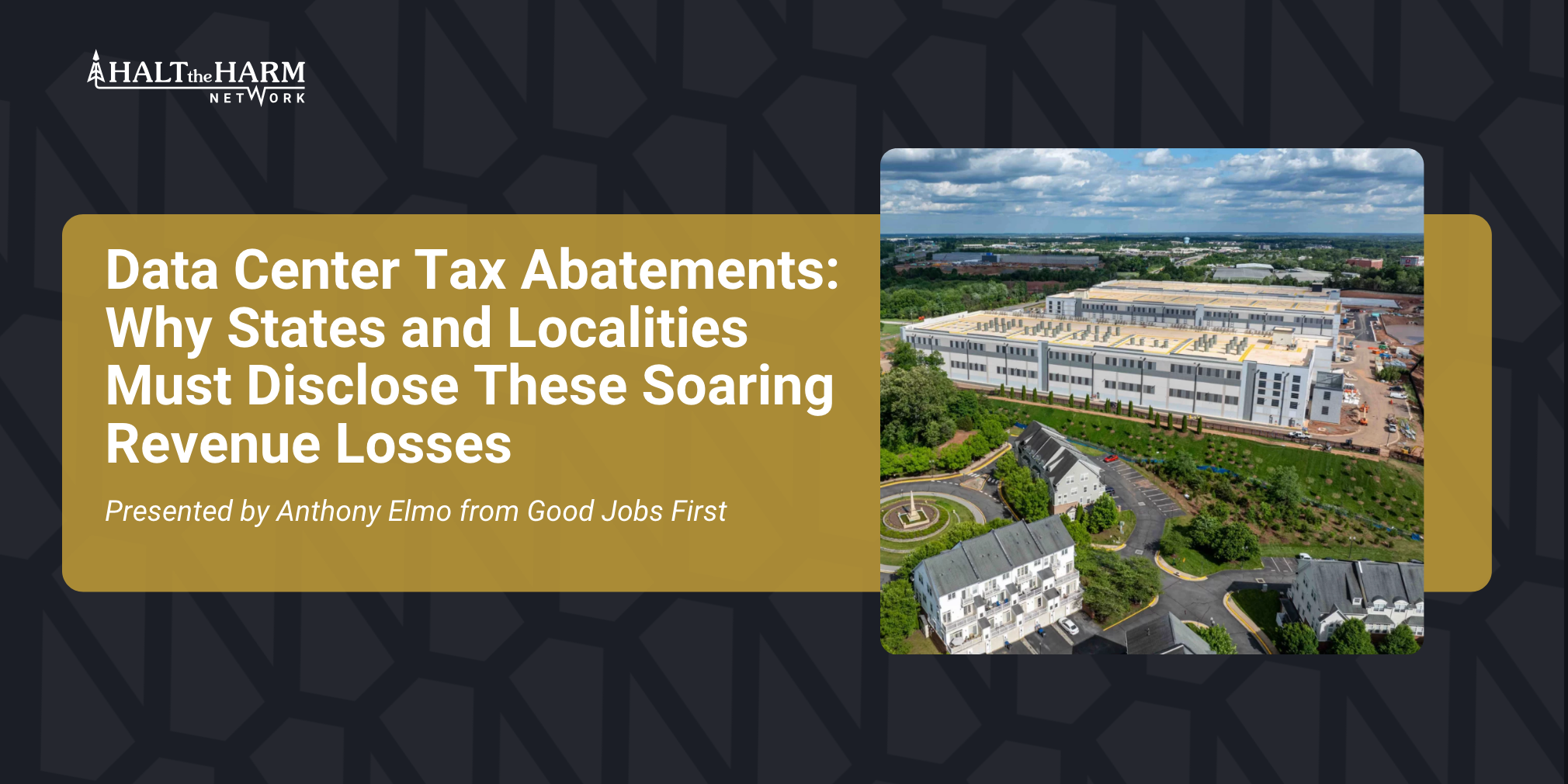
Data centers are spreading across the country, and with them, a wave of tax abatements that cost states and localities billions in lost revenue. Most of these deals happen with little public disclosure of what communities are giving up.
Learn how tax abatements for data centers are affecting state and local budgets. You’ll hear about the scale of these revenue losses, the lack of transparency in how these deals are made and what advocates can do to push for mandatory public disclosure.
This is a chance to understand the fiscal side of data center expansion. It’s increasingly relevant as these projects move into communities already dealing with the harms of energy-intensive industry.
Access the Report ↓
Fourteen states and scores of localities across the U.S. fail to disclose how much revenue they lose to data center tax abatement programs. Yet such losses are known to be soaring in states that do disclose, with three states already losing $1 billion or more per year.
Most of these failures to disclose violate Generally Accepted Accounting Principles (GAAP), as set forth by the Governmental Accounting Standards Board (GASB). Since FY 2017, those principles require most governments to disclose lost revenue when they themselves grant tax abatements. They also require other governments which routinely lose revenue passively to also disclose.
Tax-abatement laws written long ago for much smaller data centers, predating massive artificial intelligence (AI) facilities, are now unexpectedly costing governments billions of dollars in lost tax revenue. Three states, Georgia, Virginia, and Texas, already lose $1 billion or more per year.
We recommend every state and locality conform to GAAP and fully disclose their data center tax abatement revenue losses. They should also back-report their losses since FY 2017. States should also copy the exemplary model of Nevada’s Controller to annually report the local shares of revenue lost to any tax abatements awarded by the state.